A long growing season allows aroma to develop without sacrificing freshness.

A northern classic
Time held
in acidity.
Documented in the Rhine region as early as 1435, Riesling became one of Europe’s clearest expressions of site. Its long season preserves freshness while slowly building aromatic detail.
Rather than masking its origin, the variety translates slope, soil and vintage into tension, fragrance and a remarkably persistent finish.
Variety passport
Its identity,
in six precise points.
- Origin
- Rhine Valley, Germany
- First recorded
- 13 March 1435
- Type
- White Vitis vinifera
- VIVC number
- 10077
- Ripening
- Late and gradual
- Synonyms
- Rheinriesling · Klingelberger
01
02
03
04
05
06
Anatomy of the variety
Small berries.
A long memory.
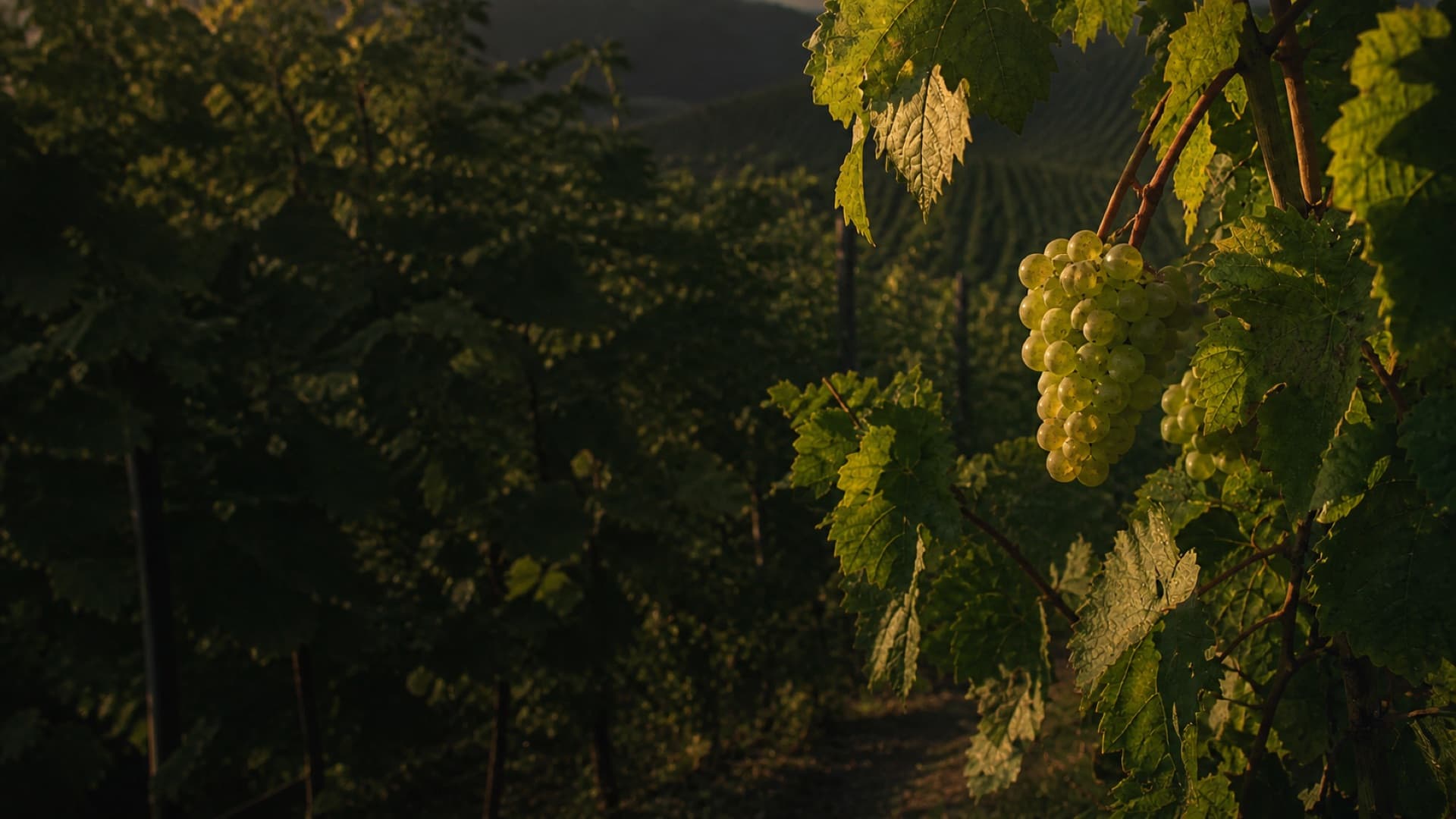
Riesling forms small, compact bunches of fine-skinned, yellow-green berries. The fruit ripens slowly and retains the natural acidity that gives the wines their precision and longevity.
Compact bunch Small berries form a recognisable, finely structured cluster.
Fine skin Delicate fruit requires attentive canopy and harvest decisions.
Natural acidity The defining source of energy, length and ageing potential.
In the vineyard
A long season.
A precise harvest.
Compact clusters carry small fruit with a delicate skin.
It provides tension, clarity and exceptional ageing potential.
Warm river slopes help complete the variety’s long cycle.
Aromatic spectrum
Citrus in the light.
Stone in the finish.
From lime and green apple to peach, apricot and subtle floral tones, Riesling combines aromatic clarity with a cool mineral line.
At Talaska
Rhine precision.
Melsztyn light.
On Talaska’s south-facing slope, Riesling benefits from sunlight above the Dunajec Valley while evening airflow protects its freshness. Clay-limestone soils bring texture without obscuring its naturally linear character.
Role in the collectionFreshness · precision · length
Botanical sources
Prepared from recognised ampelographic and viticultural sources, including VIVC, Julius Kühn-Institut and official wine-sector publications.
Variety index